
Past Newsletters
September 18th, 2026
I am still in the process of setting up an RSS feed and mailing list for updates to this site. Currently, if you want to get these emails in your inbox, you can just let me know directly.
Letter #002 - Artisanal Web Dev & Fluctuation-Dissipation Theorem (2026.09.29)
Hello friend,
I think it is important that I maintain this letter streak on a weekly basis for the sake of “getting better at communicating my work.” I have to remind myself that this is a snapshot of my work/progress/learning rather than a presentation/performance of it. So in the spirit of working with the garage door open, here are my incomplete notes on stochastic processes and half-baked ruminations on “honing useless skills” in the age of LLMs.
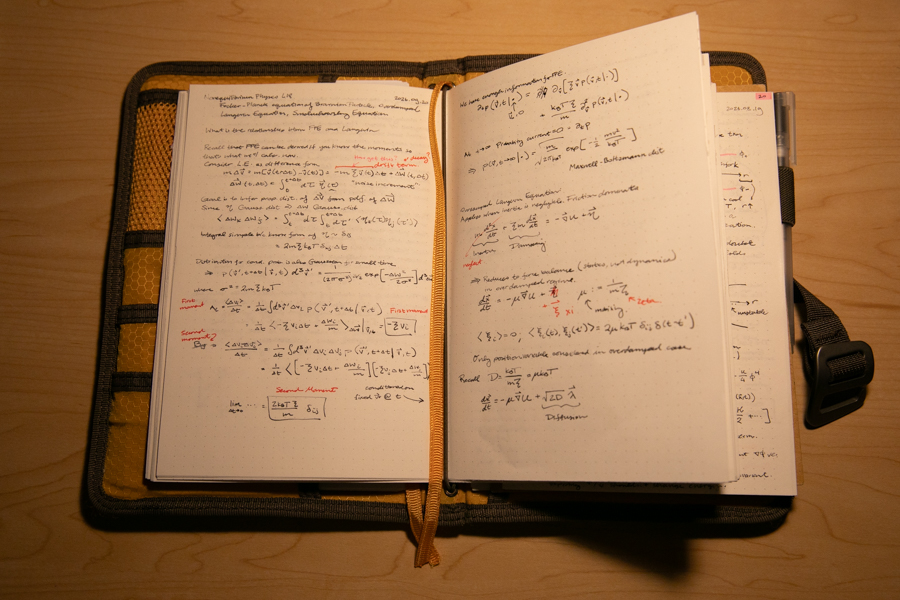
Notes on fluctuation-dissipation theorem We take for granted that we “know that the world is made up of atoms.” But if you wind back the clock to just a little more than a hundred years, you’ll realize that this “atomic” theory was widely contested. When you look at the macroscopic world around you — the books on your shelf, the cup and its water, the air you breathe — it’s not actually obvious that all these states of matter are comprised of a bunch of tiny building blocks called atoms. In fact, you could live your whole life quite happily (and successfully) without knowing about the atomic model. Your indifference to the atomic model has to do with the fact that how you go about predicting cause-and-effect doesn’t really boil down to the idea of atoms: liquid stuff like flows, objects that are pushed sufficiently hard move, fire is hot. Common sense/knowledge doesn’t depend on the validity of the atomic model at our scale.
But in the microscopic world, down to the micron scale (to fathom a micron, I like to think “a micron is to a millimeter as a millimeter is to a meter” — a thousandth of a thousandth of a meter), you can already start to feel the discrete nature of the world in the form of individual molecules and atoms.
This has been my mini preface to the fluctuation-dissipation theorem, which resides on an atomic theory (or some sort of discreteness to nature). The general idea is that: The reason why a microscopic fluctuation term and a macroscopic dissipation term are related to each other is because they come from the same microscopic origin of many particles (much smaller) bumping into the larger particle (or vice versa: larger particle bumping into many tiny particles).
See notes:
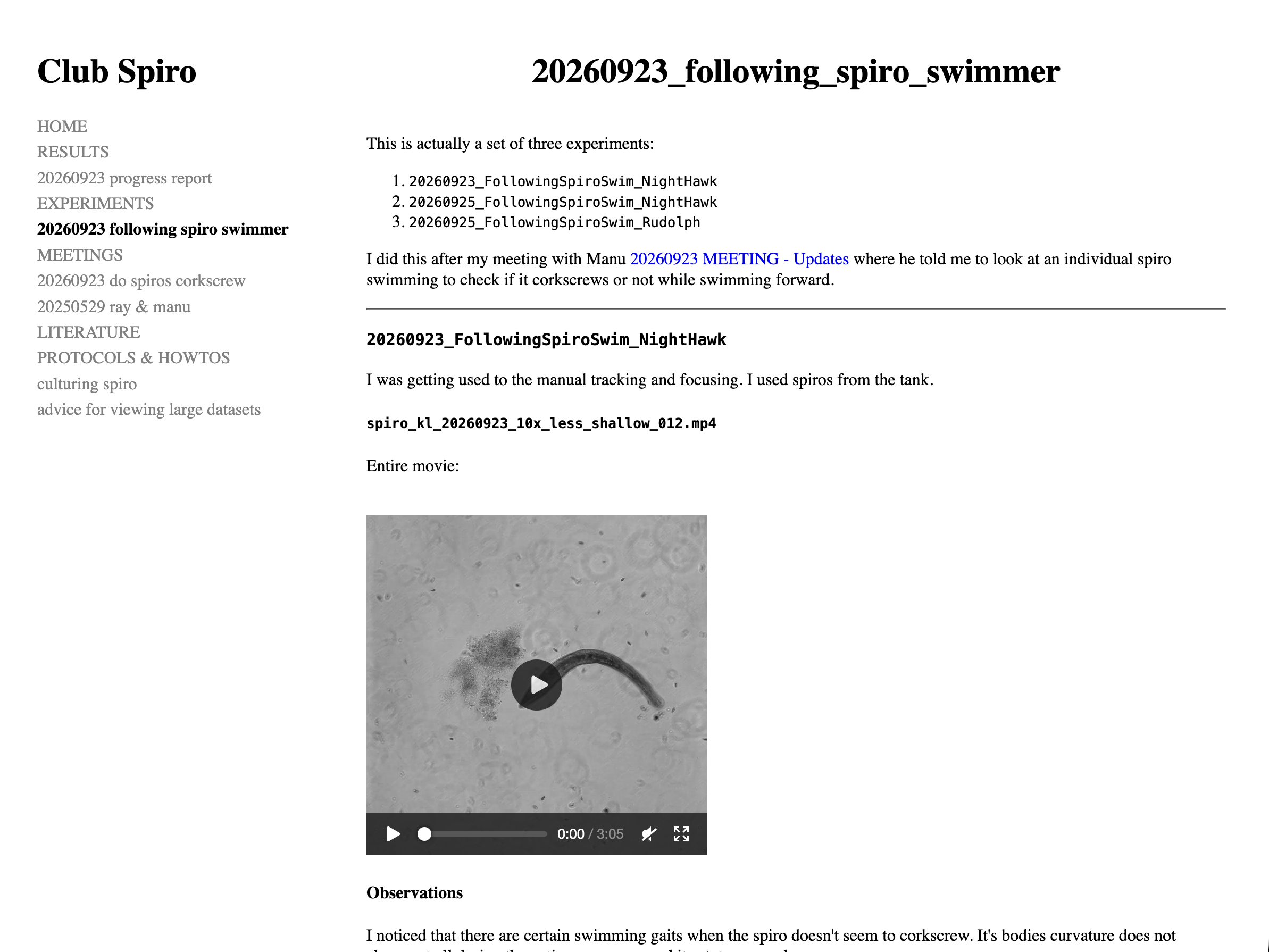
Good ol’ artisanal web dev with HTML, CSS, and JS This past week, I was playing around with some web dev with some good ol’ Fashioned HTML, CSS, and JS. I was using Flask, a web application framework in Python, to read various lab notebook entries from my Obsidian vault and display them in an interactive page. Am I just doing extra steps to recreate Notion and Benchling? Perhaps.
Yes, I was writing HTML tags by hand, and updating the corresponding CSS style sheets — by hand. But why? Why do I feel the need to sharpen this skill that been rendered completely useless when I could have just asked Claude to write it up for me and make a beautiful website? I guess what I’m pursuing is not that different from the making of “artisanal bread” or “hand-made clay pots.” Coding has become something akin to a “craft.” You derive joy and meaning from the process just as much as the final product itself. I don’t know about you, but when I go to a farmer’s market or something like an artist gallery and I purchase something, I also get the added pleasure of knowing that I’m supporting a person’s craft. Would the same apply to using hand-made code? Would people cherish it in the same way, or would they be more skeptical of it?
Your friend, Kevin
Letter #001 - My Mailing List Debut (2026.09.19)
Hello friend,
This is the first letter I am sending to you through this mailing list. It exists as a literal list of emails in Markdown file on my computer. I’ve always had the impulse to share my works in progress from graduate school, but I haven’t really found the best medium for doing so. I’ve thought about sharing them on social media platforms (Instagram, LinkedIn, Facebook, Bluesky), but they are full of algorithmic noise and established cultural norms. Having direct conversations with friends and family about my work has always been rewarding, but it’s missing the “consistency” and “accountability” aspect that would help me improve my craft. Perhaps a “mailing list” would do. It strikes a fine balance between these two modes of communication. It could help me feel a greater sense of “accountability” that comes with scale, while also maintaining the “personability” of reaching someone right at their inbox.
I do not know if this “mailing list idea” will work. But there is no better way to find out than to try.
Ongoing struggles breaking into a new field
Since starting graduate school, I’ve been trying to break into the field of “active matter.” This field is relatively new (popularized by Sriram Ramaswamy), but its predecessor ideas are quite old (statistical mechanics, condensed matter physics, hydrodynamics, thermodynamics). Regardless, the rebranding of the body of knowledge has breathed new life into it. Perhaps because of its emergence from a primordial soup of older topics, it feels that I am grappling with an entire zoo of disparate ideas. They have a similar theme, yes, but I can’t put my finger on it yet.
These past few weeks, I’ve watched a few of Prof. Erwin Frey’s lectures on pattern formation to better understand Ostwald Ripening and its role in pattern formation. You can see my scattered notes and equations on my website. Pushing these notes onto the web made me realize that I need to streamline how I format my notes for publishing. It also made me think about what’s the best way for technical material to be presented in the first place (do math textbooks do a good job? What are websites that present math/physics clearly?)
See note: Ostwald Ripening
Fixing a camera lens
Back in August, my favorite camera lens, my beloved Canon EF 24-70mm f/2.8 II USM broke. Buying a new one could cost up to \$2,200. Sending it for repair could cost around \$500 or more. But learning how to repair it following this YouTube video and buying the replacement part — a mere \$32. Of course, repairing something yourself comes with the risk of absolutely breaking it is always a risk. I accepted this risk in favor of possibly learning something I wouldn’t have otherwise.
For the past two months, I’ve taken apart and put back together my lens several times. Just this week, I finally managed to repair it!
These clips are more or less raw footage of my final attempt to repair. Transient conversations with Brandon Wong from my lab spurred me to start recording my own process. I will learn video filming, editing, and voice over edits another time. As you may see, I am having a hard time keeping the camera in focus and lighting is questionable. But for now, I am just happy tso have my lens back.
See note: Lens Repair - Canon EF 24-70mm f/2.8 II USM
Your friend,
Kevin